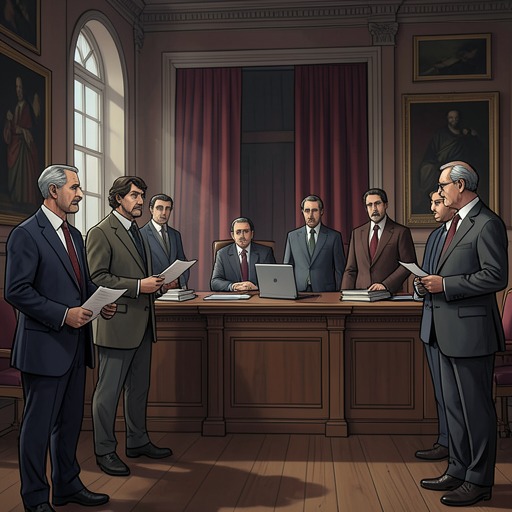
The trial over the crossed cheque
Finnegans WakeThe trial over the crossed cheque turns a disputed payment into a farcical test of how legal claims, commercial instruments, and personal status can be made to contradict one another. A debt is not seriously disputed; the case instead asks whether a crossed cheque satisfied it, who could validly receive its value, and whether the court can settle obligations that have been circulating through the country for generations without producing a single coin.
Background and Competing Claims
The case begins with a claim for tithes owed to a church emergency fund. The fund’s trustee, a resigned civil servant, brings the action against a business associated with the sale of proprietary goods. The defendants maintain that payment has already been made, and the vouchers support the existence of the debt. The dispute therefore concerns not whether money was owed but whether the form and destination of the tender extinguished the liability.
The trustee, named Coppercheap, counters that payment was invalid because it was offered under cover of a crossed cheque. The cheque was signed in the name of Wieldhelm, Hurls Cross, and drawn by the senior partner, who alone had made the deposit, even though the account stood in the names of both partners. The bank refuses to pay the draft despite having sufficient reserves. Coppercheap then negotiates it to a notary in exchange for legal relief between trustee and trust. The competing accounts make the cheque at once a rejected means of payment, a transferable instrument, and the basis of a further settlement.
The Cheque and Its Circulation
The cheque is described as pink, washable, and embossed with a number and a figure. It has circulated for more than thirty-nine years among holders of Pango stock, a rival concern, although no hard coin or liquid cash has ever passed across a counter in exchange for it. Its prolonged movement gives the instrument a social life independent of its practical monetary value: it continues to stand for claims even as payment remains unrealized.
The proceedings broaden as the court tries to identify parties capable of answering for the transaction. The original firm has disappeared into an ancient moratorium, and a mandamus cannot locate its former members. Only the junior partner, Barren, can be found. The case thus brings the administrative problem of enforcing an old obligation into collision with an increasingly unstable account of who owns, owes, or can transfer it.
Ann Doyle’s Testimony
A juror identified as the junior partner is subsequently revealed as Ann Doyle, a woman from a working-class background who has taken her place in the jury box under a male identity. After leaving the panel, she testifies about her dealings in financial instruments. She says that, when pressed, she discounted Mr Brakeforth’s instrument at nine months from its date and recounts having received assignations for services rendered. She endorsed these instruments to successive payers and drawers, whom timber papers identify as familiar figures in the city and its suburbs.
Doyle also asks to present a contribution on sheets of music paper, which is handed to the bench for private inspection. She proposes a settlement that would reunite her in partnership with the trustee, Monsignore Pepigi, under the new name Will Breakfast and Sparrem. The proposal is rejected on appeal. Her testimony and proposed arrangement shift the case from a narrow disagreement over a cheque to a broader, comic examination of credit, gendered identity, and the legal capacity to enter contracts.
Verdict and Legal Paradox
The jury, described as a dozen men all named after Doyles, disagrees. The judge then disputes the jurors’ disagreement and acts beyond his stated jurisdiction by ordering a garnishee attachment against a neutral firm. On appeal, Judge Jeremy Doyler reverses the lower court’s findings and concludes that Ann Doyle was born into contractual incapacity. The decision invokes the case of the Calif of Man v the Eaudelusk Company and the principle that no property in law can exist in a corpse, citing Hal Kilbride v Una Bellina. It follows, in the judgment’s deliberately destabilizing reasoning, that Pepigi’s agreement is worthless and Wharrem will have to do without the expected money.
The episode ends not with a clean resolution of the original debt but with legal authority exposed as another party to the confusion. The cheque remains a recognizable promise that has never matured into cash; the verdict invokes incapacity and the absence of property in a corpse to invalidate the proposed pact; and the court’s successive decisions refuse the simple closure the litigants seek. By making commercial exchange, identity, evidence, and legal doctrine crowd into one proceeding, the trial presents law as a system in which formal rulings can amplify, rather than dispel, uncertainty.